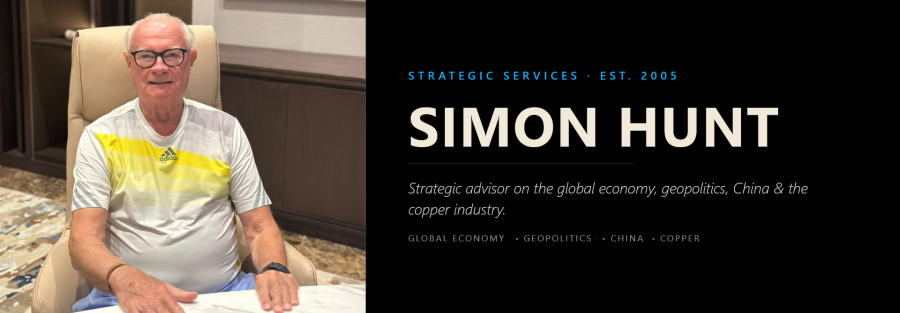
When commentators discuss the global economy, they tend to focus on the visible: an election outcome, a central bank rate decision, or the latest flashpoint in the Middle East. These headlines move markets and shape sentiment, but they rarely capture the deeper currents at work. Simon Hunt argues that some of the most important forces shaping the years ahead operate on a far longer timescale than any news cycle. To understand the Simon Hunt global economy outlook, it helps to start with the long cycles he watches most closely.
What the Simon Hunt global economy view tells us
At the centre of his framework sits the Benner Cycle, a chart first published more than 150 years ago that has tracked major turning points with notable consistency. It identifies 2026 as a peak and 2032 as the close of a 100-year cycle that began during the depths of the Great Depression. Hunt does not expect a straight line between now and then. Instead, he anticipates a sequence of shorter cycles marked by recessions, inflationary surges, rallies, and booms before the cycle ends in a bust.
Much of his analysis begins with geopolitics. Recent meetings involving Russia, China, and Iran point, in his view, to a broader transition from a unipolar world to a multipolar one. That shift is still in its early stages, but Hunt believes it will define the coming six years. Energy sits at the heart of this story. With Iran asserting greater influence over the oil routes leaving the Middle East, any change in supply, transport, or pricing eventually filters through manufacturing, agriculture, and consumer markets across the global economy.
Against this backdrop, Hunt expects the current market correction to continue before giving way to a substantial relief rally, with equities potentially climbing well above current levels. He then sees recessionary conditions developing across much of the world, followed by a renewed inflationary surge between 2028 and 2032 driven by fiscal and monetary policy, rising food prices, fertiliser shortages, and weather-related disruptions. He compares the environment ahead to the inflationary years of 1978 to 1982.
For Hunt, these are not separate stories. Economic pressure, geopolitical realignment, inflation, and monetary policy are all unfolding within the final years of a century-long cycle. Readers may recognise Simon Hunt from his commentary in City AM, where his long-range views on commodities and markets have featured over the years. The same perspective informs the work he does through Simon Hunt Strategic Services, which provides strategic services and research to clients navigating these long cycles.
Whether the precise forecasts prove correct remains to be seen. The broader point is what matters most: the next six years may not simply mark the end of another market cycle. They may mark the end of a century-long era, and the strategic services and research Hunt offers are built around helping clients prepare for exactly that kind of transition in the global economy.